Passion to
Story Telling
An Eye on You (A.I. on You), 2025
Submitted to YoungArts in Film (2026)
Director, Writer, Editor
This film...
Graceful Ghost, 2024

YoungArts National Winner in Film (2025)
Director, Writer, Editor
As someone called to military service,..


Law Day, 2024
Honorable mention
2025 Law Day Video Contest by Superior Court of California County of Santa Clara
Director, Writer, Editor
Chaos, 2023
Self-Driven
Director, Writer, Editor
Elementary Graduation, 2018
Selected as one of student co-directors and interviewers
Director, Interviewer, Editor
Introduction to Blue Hills Elementary School, 2018
School-wide Talent Show Winner
Director, Writer, Drone Pilot
Add a Title


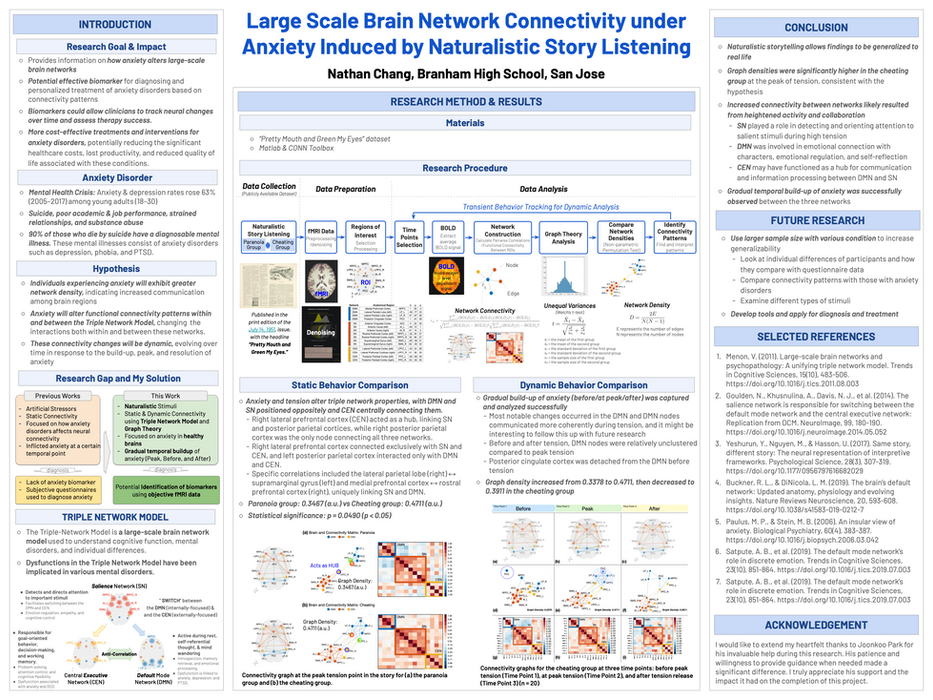
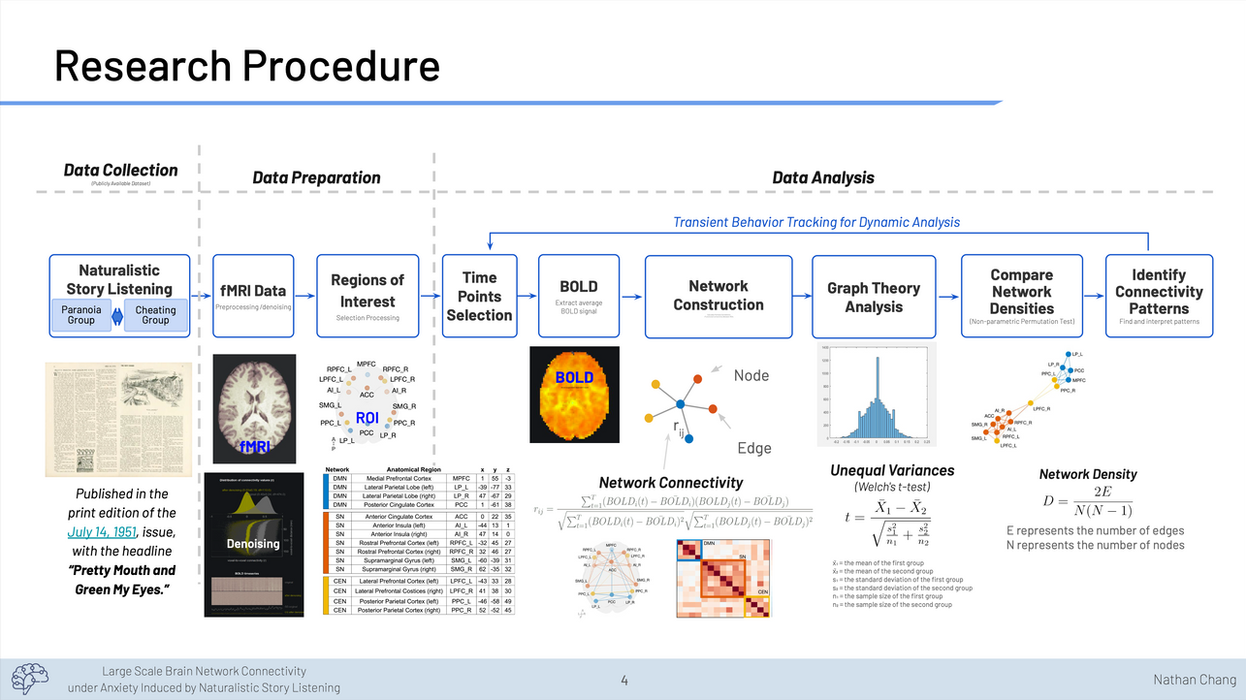
Large-scale brain network connectivity under anxiety induced by
naturalistic story listeningNathan Chang (Single Student Author)
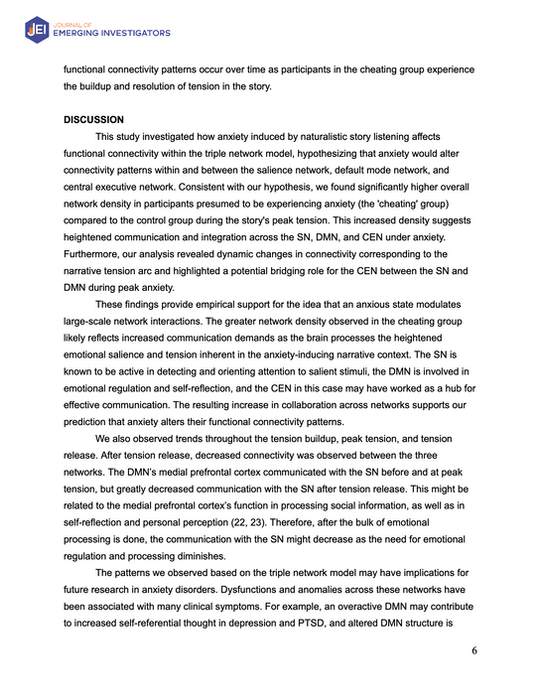
The triple network model, based on the salience network (SN), default mode network (DMN), and central executive network (CEN) in the brain, provides a framework for understanding how anxiety influences brain activity. Here, we hypothesized that the functional connectivity patterns of these networks represent anxiety. This hypothesis was tested using a previously published functional magnetic resonance imaging (fMRI) dataset in which the level of anxiety was experimentally manipulated while participants listened to a modified short story. The story, Pretty Mouth and Green My Eyes, was narrated to two different groups; one received a backstory designed to elicit anxiety (experimental) while the other did not (control). Based on our hypothesis, we predicted that the functional connectivity within the three networks differs between the two groups at the point where the tension of the story reaches its maximum. Consistent with this prediction, the network density (the degree to which different brain regions communicate with each other) was significantly greater in the experimental group compared to the control group. In particular, the CEN serves as a bridge tightly connecting the DMN and SN, which may be interpreted as empathy and emotion coming together under focused attention when experiencing tension. Our findings demonstrate that anxiety and tension during reading significantly alter the functional connectivity of the SN, DMN, and CEN. This research provides a possibility for creating more accurate diagnostic tools and personalized treatments for anxiety disorders by comparing the connectivity patterns of those without and with anxiety disorders.
Presented at
2025 JSHS North California Regional




Presented at Stanford High School Neuroscience Forum (April 19, 2025)






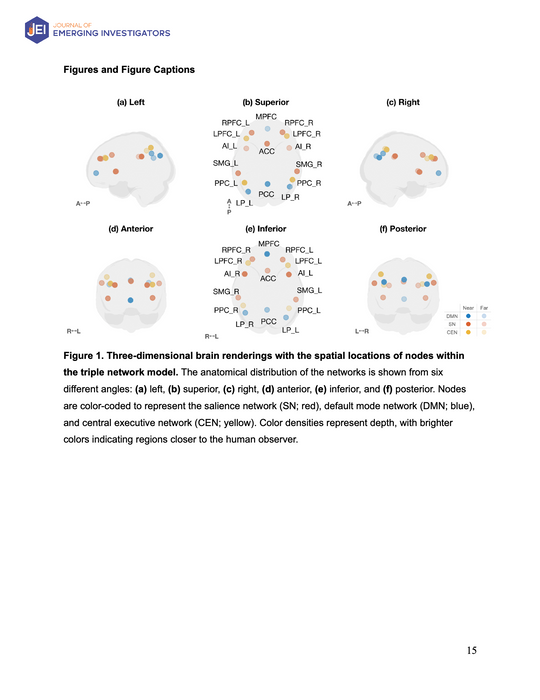


Accepted at The Journal of Emerging Investigators (Expected to publish at Winter 2025)


Presented at Synopsys Championship
at Santa Clara Valley Science Fair (2025)Submitted to Journal Paper (Oct, 2025)
Co-optimizing Hardware and Algorithms:
Dynamic Vision Sensor Integration with CNN for Image RecognitionNathan Chang (Co-Author)
Miniature imaging systems are used in space-constrained applications but struggle with limited memory for image storage. Machine learning algorithms offer a solution by extracting essential information and reducing data size, but their high power and energy demands exceed the capacity of miniature systems’ small batteries. This paper presents a hardware accelerator for convolutional neural networks (CNNs) optimized for object classification in miniature imaging systems. The design reduces computation by leveraging a spatial dynamic vision sensor with ternary outputs and employing a ternary-input, binary-weight neural network. By skipping multiplications for zero-valued inputs and replacing complex multiplications with simple XOR operations using binary weights, the accelerator significantly cuts computational costs. Designed in a 28 nm CMOS process, the accelerator optimizes data loading, reducing data size by 81% and multiply-accumulate (MAC) operations by 27%. The chip achieves 44 ms per inference while consuming 6.8 mW. Compared to the state-of-the-art CNN accelerators for miniature systems, it improves the figure-of-merit by 176×.


Drug Prevention Education: Health Education Initiative Advocacy
(June-Aug 2024)
June-Aug 2024, 130+ international students
- Stanford REACH Lab, Office of Senator Cortese, and Michigan Department of Health & Human Services
Session I
Session II
Session III (Student-Led)

Flyer
Session 3 Slide
Certificates
Introduction to Stock-a-thon (Nov-Dec 2024)
Nov-Dec 2024, 20+ participants
Initiated student involvement in community fundraising via the United Congressional Award Club network and co-hosted a virtual stock trading platform webinar
Webinar Recording


Slide

Flyer
Certificates
Donation for Medical Device
Building Disaster Resilience for Community (Feb-April 2025)
Arranged two professional speakers and led five student speakers with 90+ international participants
Explained how to strengthen community resilience against climate-induced natural disasters through legislative action, mental health support, and public wildfire catastrophe modeling
Webinar Recording
Slide

Flyer
Certificates
Agenda
From Notes to Neuron (July-August 2025)
Arranged three professional speakers and led six student speakers with 120+ international participants
Examined how a volunteer music program transformed simple notes into meaningful bonds, investigating the resulting emotional, cognitive, and social benefits for nursing home residents and student musicians.
Explained how to strengthen community resilience against climate-induced natural disasters through legislative action, mental health support, and public wildfire catastrophe modeling
Webinar Recording
Slide
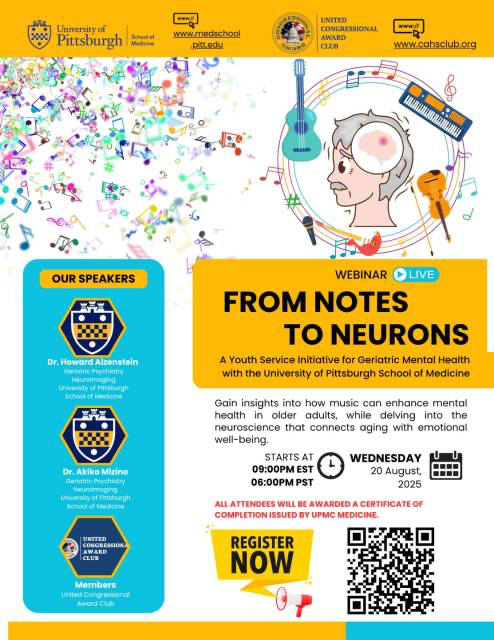
Flyer
Certificates
Youth Leadership in Brain Health (October-November, 2025)
In-progress, with Alzheimer's Association and Frederick National Lab

Flyer

Hi, I’m Nathan.
From Cognitive Research to Community Narrative by Film: Applied Well-being of Our Community


Nathan Chang
Email: hochaechang@gmail.com
Branham High School, San Jose, CA